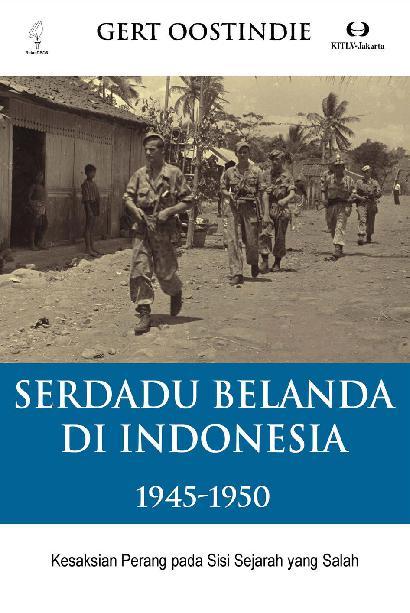
Dutch Soldiers in Indonesia (1945-1950)
The sixth and ninth of August are crucial dates in the history of this nation, there have been events that sparked the spirit of the Indonesian people to break free from the colonialists. The events of the nuclear bombs in Hiroshima and Nagasaki seemed to be a prologue to Indonesia's independence which was then colonized by Japan, in that war situation this country was also born to the surface.
Indonesia, which had just declared independence on August 17, 1945, was furious at the Dutch efforts to regain control of Indonesia. The failure to reach an agreement between the two sides led to a war with the sending of 220,000 Dutch soldiers to Indonesia during the 1945-1950 period. The period which was later named the Revolution was a transitional period for Indonesia to maintain its independence.
The large number of soldiers deployed during the Revolution did not make the Netherlands a victor. As a result, the Dutch had to withdraw all their soldiers to return to their homeland. The end of the Revolutionary war did not necessarily erase the memories of the Dutch soldiers regarding the crimes they had committed. The memories of the Dutch soldiers were the subject of the writing of the Dutch Soldiers in Indonesia 1945-1950 by Gert Oostindie, Director of the Institute for Research, Voor Taal-, Landen Volkenkunde (KITLV) as well as Professor of History at Leiden University. The urgency of this book is to describe facts about the revolutionary war crimes in Indonesia through the collective memory of Dutch soldiers.
Oostindie admits that this book cannot represent all Dutch soldiers, but this book can serve as a reference for alternative information regarding the period 1945-1950. The sources that Oostindie used to display the memories of the Dutch soldiers were ego documents which included diaries, personal letters, biographies, and interviews. This source is quite interesting because it uses the point of view of Dutch soldiers who are positioned as perpetrators of war. This point of view is also rarely found in Indonesian history, which according to R. Moh Ali in Introduction to History (2005) is still controlled by the government and emphasizes the political aspect.
Based on the memories of the Dutch soldiers, they agreed to be assigned to Indonesia because they were persuaded by propaganda or received threats from the state. The lack of information about Indonesia made the soldiers not aware of the real conditions in the field. The understanding of the Dutch soldiers assigned to Indonesia was only to secure Indonesia which was still part of the Dutch territory from Japan and nationalists who committed mischief. This understanding is different from Indonesian history which considers that the 1945-1950 war was carried out to defend independence from the Dutch who wanted to regain control of Indonesian territory. This difference in understanding gave rise to sentiment between Dutch soldiers and Indonesian guerrillas during the war.
Various difficulties in the war and Dutch abuse of Indonesia caused the soldiers to change their understanding. This can be seen from the failure of political agreements such as violations of territorial boundaries by Indonesia, so that Dutch soldiers were often threatened by guerrilla movements. In addition, the soldiers thought that the Netherlands should not go to war because Indonesia was entitled to its independence. In fact, some soldiers thought that the Dutch treatment of Indonesia could be likened to the German crimes against the Dutch in World War II who deported youths to concentration camps.
Even so, the Dutch soldiers' understanding of Indonesian independence changed again because not a few Dutch soldiers died at the hands of Indonesian guerrillas. As a result, other Dutch soldiers took revenge by killing more guerrillas as well as ordinary people. War crimes also occurred when Dutch soldiers interrogated Indonesians. They did not hesitate to torture and kill Indonesians in order to get information about the targets for arrest. The information obtained was also not necessarily correct, so the Dutch soldiers were often not on target. However, war crimes were not only committed by Dutch soldiers, Indonesian guerrillas also killed the soldiers. This was mentioned in the records of Dutch soldiers which explained about the sadism of Indonesian guerrillas such as mutilating body parts and throwing them on the streets.
Besides explaining the various crimes during the 1945-1950 war in Indonesia, Oostindie also discussed the lives of Dutch soldiers during the war. Initially the soldiers were able to send letters to their families in the Netherlands to reduce their boredom. However, the government finally prohibited them from sending letters due to the high cost of shipping. The breakdown in communication and boredom in war led the Dutch government to provide entertainment facilities such as religious rituals, sports, films and parties. Not a few Dutch soldiers also vented their boredom to prostitution places, so that not a few of them died due to venereal disease.
The life of Dutch soldiers after the war is also explained in this book. There were soldiers whose arrival was warmly welcomed, but many also had difficulty adapting to their environment because they were considered to have lost the war. This difficulty was also caused by the Dutch people's lack of understanding of the Revolutionary war and war crimes committed by soldiers. The lingering memories of war crimes make the soldiers often haunted by guilt. Some of them even need psychological treatment. In addition, some have returned to Indonesia to apologize to the families they think have hurt.
Born from the embryo of a tense and inhuman war atmosphere, Indonesian history is closely related to wars and power struggles. It can be said that the history of Indonesia is a history that is bloody, a history full of victims, a history that is red. How could it not that for almost more than three centuries Indonesia was forced to serve the barbaric desires of the colonizers, from the Netherlands, England to Japan.
So there are countless Indonesian historical literature on the topic of war, whether it is written by Indonesian or foreign historians. Almost all examples of the literature tell how the colonial war, the war for independence, and the physical revolution that occurred after Indonesian independence. Told in detail and with charming chronological flavor.
However, the problem is that it is almost certain that some of the literature tells of warfare from an Indonesian perspective. So in the book only one plot is provided, a story about warfare according to Indonesian soldiers.
This is natural because most of the literature on the history of Indonesian warfare was written after 1957, the year the first National History Congress was held in Yogyakarta, which decided that national history should be written from an Indonesian perspective. What is meant is that in every national history book, the Indonesian people must be the main focus. Commonly called the Indonesian centric ready-to-use style.
This organizational style developed over time, becoming a national identity that had previously been dreamed of. Much new literature has been launched using this style, and much of the previous national historical literature was re-examined to conform to Indonesian-centric standards.
Not many deviated from the Indonesian style, until finally the book Serdadu Holland in Indonesia came to be an anomaly that shattered tradition. The book that I reviewed is like a hipster, as a match that is ready to provide an alternative to readers - especially about the history of national warfare.
The style of language in this book is of added value to the literature on the history of national warfare, taken from a central Dutch point of view which clearly contrasts with what is often presented in the literature. This style can be clearly seen by the background of the author who is indeed a real Dutchman as well as the director of the Dutch studies center for the Asia and Kep. The Caribbean makes this book look like a perfect rival.
Through this Dutch-centric style of writing, the writer tries to question stereotypes that have been formed as a discourse on the history of national warfare, such as "whether the Dutch army was indeed wild soldiers who were brutal, vicious and tortured Indonesian civilians" and "is it true that Dutch soldiers came to the Indies only armed with motives? Gold, Glory and Gospel ”.
In addition to the unique writing style, the plus point of this book is the historical sources it uses. In any historical research, historical sources are divided into two types: primary and secondary. And still within the scope of the research, it is not uncommon to find difficulties in finding primary sources written at the time when the event took place. Inevitably, researchers are required to rely on secondary sources which are sometimes biased.
What is amazing is that this book is able to collect and present a very rich primary source, through a corpus of ego documents in the form of diary books, memoirs, interviews, biographies, correspondence with family or colleagues who managed to record the activities of Dutch soldiers during the post-independence political action in the Dutch East Indies.
The use of the ego document indirectly increases the authentic value of the historical source itself, besides that it can also affect the accuracy of the data presented because it is not too far away when the event occurs. The ego document also serves to show that this book presents a view of history from below.
In that sense, the history presented here belongs to people who are not very influential - in this case the Dutch soldiers -, history is seen as something universal and does not belong to heroes and figures who make it into a long list of influential people but belong to all human children. .
In fact, this type of history is more humanistic and sentimental, and this book has proven to be successful in building a stigma that makes the reader feel personally. Through fragments of interviews, the writer tries to convey these intimate nuances.
Before ending this review, it should be noted that in every war there is a testimony from the perpetrators of violence who actually do not want to do this, the majority of wars are based on political policies that sacrifice the military like pawns. Like most, the period of physical revolution is clear evidence of the large number of victims who are willing to fight for political interests, and the victims are the military soldiers themselves.

